
B2B ecommerce sites: Stop acting as digital brochures
A significant majority of B2B buyers demand self-service capabilities, forcing a rapid departure from legacy sales-dependent models. This shift proves that modern B2B ecommerce sites must function as reliable data stewardship engines rather than simple digital brochures. The core argument posits that successful enterprise platforms rely on smooth data synchronization between ERP and PMT systems to maintain accuracy. APA Engineering notes that effective software enables the transfer of information in various formats to PMT through FTP, often scheduling these updates automatically at night. This automation eliminates manual entry errors while ensuring price customization and stock details remain current across all user interfaces.
Readers will learn the specific mechanics of Admin Panel operations, where sales teams collaborate to optimize product catalog design for maximum volume. We will also dissect the technical requirements for executing YMM integration and managing complex bill of material structures without disrupting live transactions. Finally, the discussion covers how Multitheme Customization supports distinct Customer Panel experiences while maintaining a single source of truth for all commercial data.
The Role of B2B E-commerce in Modern Data Stewardship
Defining B2B E-commerce as a Cloud-Based Data Steward
Stop viewing your platform as a transaction terminal. In reality, B2B e-commerce functions as a cloud-based data steward that maintains and exports vital inventory records. This definition shifts operational attention from pure sales volume to data integrity, mandating that ERP integration synchronizes stock levels automatically during off-peak windows. The architecture enables the transfer of information in varying formats to production management tools using standard file transfer protocols. Such design directly addresses buyer demand, as a significant majority explicitly require the ability to self-serve part or all of their purchasing workflow.
| Feature | Function | Data Impact |
|---|---|---|
| Admin Panel | Customizes price levels | Enables factor-based updates |
| Customer Panel | Tracks order history | Maintains persistent records |
| Search Module | Enables VIN lookup | Increases match accuracy |
Platforms including Cloudfy separate themselves by delivering the deep ERP integration necessary for these complex enterprise workflows. Rapid deployment schedules often clash with data fidelity requirements. Operators must prioritize systems treating the catalog as a living database demanding constant validation. True stewardship means the platform exports clean data as reliably as it captures orders.
Operationalizing Admin and Customer Panels for Data Flow
The dual-panel architecture separates catalog governance from buyer self-service, preserving data integrity throughout the supply chain. Inside the Admin Panel, product catalog design teams collaborate directly with client sales groups to build professional, optimized designer catalogs that drive volume. This interface permits users to customize price levels based on specific factors while viewing complete sales order or invoice histories. Stock import data appears beforehand, granting operators a quick glimpse of sales orders before finalizing updates. Web pages support multiple themes, enabling distinct visual identities for different buyer segments without backend code modifications.
The Customer Panel concentrates on rapid retrieval and history tracking for mechanics and distributors. Users maintain a persistent record of past transactions while using strong search functionality to locate parts by identifier or application. Responsive pages guarantee access across devices. Scratch pad features allow buyers to compile lists before converting them into orders. Traditional sales models frequently involve high operational disruption when changing vendors, creating a hidden switching cost locking buyers into legacy systems despite superior options elsewhere.
Data synchronization between these panels and external ERP systems configures to occur automatically during night cycles or on a timely basis. Scheduling prevents daytime latency while ensuring inventory counts reflect real-world availability. This approach balances the necessity for accurate data with the requirement for a responsive user interface.
B2B E-commerce Platforms Versus Traditional Static Catalogs
Modern B2B platforms replace fixed print lists with flexible, ERP-integrated systems updating stock instantly. Traditional static catalogs fail because contact data decays at an industry benchmark rate of approximately 30% per year, rendering printed pricing obsolete quickly. Digital portals address this failure by synchronizing bill of materials and inventory levels automatically without manual re-entry. This shift enables responsive pages adapting to buyer history rather than displaying uniform information to every visitor.
| Feature | Static Catalog | Flexible B2B Platform |
|---|---|---|
| Data Freshness | Fixed at print date | Real-time sync via ERP |
| Pricing Model | Uniform for all buyers | Customizable by account tier |
| Search Depth | Limited to index | VIN, BOM, and competitor cross-ref |
| Update Cost | High reprint expenses | Negligible digital maintenance |
Maintaining legacy static channels diverts capital from necessary digital infrastructure. Investment in AI and machine learning integration requires significant upfront expertise, yet generic tools often lack native enterprise workflows found in purpose-built solutions. A conflict exists between low initial printing costs and long-term revenue loss from outdated information. Traditional advertising spending in the United States is projected to reach billions, that capital increasingly funding digital autonomy tools buyers demand. A static PDF cannot offer the scratch pad features or multi-promotional logic required for complex automotive sourcing. Paper limitations are absolute; physical media cannot execute the stock import previews or invoice history retrieval modern procurement expects.
Inside the Architecture of ERP and PMT Data Synchronization
Mechanics: Defining B2B Data Synchronization Mechanics
Nightly syncs bridge ERP and PMT systems to reset inventory accuracy before daily trading windows open. This data synchronization process automates the transfer of information across varying formats so stock levels reflect physical reality despite rapid attribute decay. Without this automated reset, a database purchased with 90% accuracy drops to roughly 63% accuracy after one year without re-enrichment. Operators should automate syncs when manual updates cannot match the velocity of catalog changes or pricing adjustments. Leading platforms enable this through deep ERP integration designed for complex workflows and real-time synchronization. The mechanism typically follows a scheduled sequence:
- System extracts delta changes from the source ERP database.
- Data transforms to match the target PMT schema requirements.
- Files transfer via secure protocols during off-peak maintenance windows.
| Sync Mode | Frequency | Best Use Case |
|---|---|---|
| Nightly Batch | Once per 24h | High-volume catalog resets |
| Timely Trigger | On-change event | Critical price updates |
Latency presents a constraint; batch processing creates a window where digital stock may diverge from physical counts. The alternative of continuous real-time locking often degrades system performance during peak buyer activity. Automation reduces the manual effort required to maintain long-term accuracy.
Deploying YMM, VIN, and BOM Search Logic
Precise part matching begins when YMM integration maps vehicle attributes to catalog SKUs, eliminating guesswork for mechanics sourcing components. This architecture supports search via BOM, VIN, vehicle name, part type, or competitor numbers, ensuring buyers locate exact fits without manual cross-referencing. Such granularity addresses the reality that less than 50% of buyers desire phone contact, pushing platforms to prioritize digital autonomy over sales intervention. The system resolves data sync issues with PMT by automating transfers between ERP and production tools, preventing the inventory drift that plagues static databases.
| Search Method | Primary Input | Operational Value |
|---|---|---|
| YMM Logic | Year, Make, Model | Filters catalog to compatible applications |
| VIN Decode | 17-character ID | Identifies factory-specific equipment |
| BOM Lookup | Assembly Diagram | Matches sub-components to master lists |
Operators must note that VIN search offers high precision yet relies on clean data ingestion; erroneous inputs yield zero results, frustrating users seeking immediate fulfillment. Syncing these complex queries requires strong APIs because standard file transfers may lag during high-volume trading windows. Computational overhead is the limitation: real-time validation across multiple formats demands stronger server resources than simple keyword matching. Enabling these search vectors transforms a static list into a flexible self-service hub, accommodating the majority of modern purchasers who prefer automated workflows. The structural link between vehicle identity and part number remains intact for reliable procurement even as contact details decay.
Mitigating Data Decay and Infrastructure Gaps
Infrastructure gaps prevent timely updates, causing inventory drift that misaligns digital stock with physical reality. When sync logic fails to execute nightly, the platform cannot correct for the natural volatility of contact and fitment attributes. This decay creates a hidden recurring cost for verification services, forcing teams to manually resolve stock import errors that automation should catch. Despite these risks, 29% of marketers admit they still lack the correct technology stack to manage content and data effectively (technology stack). Listed availability diverging from warehouse truth causes a compounding loss of buyer trust.
| Failure Mode | Operational Impact | Required Fix |
|---|---|---|
| Missed Nightly Sync | Inventory counts remain stale | Enable automatic FTP transfer |
| Format Mismatch | PMT system rejects import | Map fields to YMM standards |
| No Re-enrichment | Contact data becomes invalid | Schedule quarterly validation |
Troubleshooting data sync issues requires verifying that the ERP pushes updates before the trading window opens. High-value transactions stall without this discipline. Over one-third of buyers are now willing to commit to digital transactions exceeding $500,000 (digital transactions), but only if the displayed data reflects immediate availability. Operators must prioritize infrastructure that enforces strict synchronization schedules to avoid the inefficiency of manual reconciliation.
Executing Smooth Integration and Customization for Enterprise Catalogs
Defining Price Levels and BOM Management Capabilities
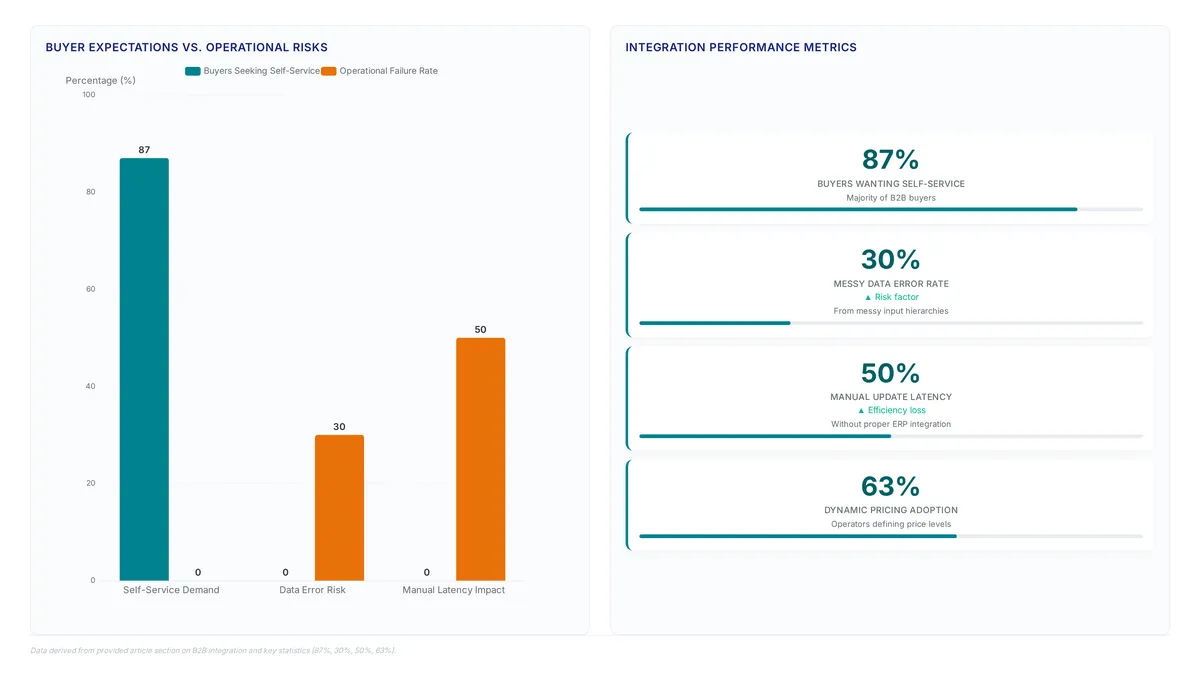
Should you stock OE, premium aftermarket, or both for this application? Here's the math: price customization within the Admin Panel allows distinct tiers based on buyer value rather than uniform listing. Operators define price levels depending on factors such as volume commitments or contract status, updating them dynamically as market conditions shift. This flexibility supports the majority of buyers seeking self-service options without sacrificing margin control.
- Configure tiered pricing rules mapped to specific customer groups.
- Link Bill of Material structures to vehicle applications for accurate bundling.
- Enable automatic synchronization with ERP systems to reflect real-time cost changes.
| Capability | Static Approach | Flexible B2B Model |
| Price Updates | Manual re-entry | Factor-based automation |
| BOM Visibility | Hidden in invoices | Easy management view |
| Integration | None | ERP connected |
However, implementing complex BOM management requires clean data hierarchies; messy input creates quoting errors that erode trust. The cost of rigid pricing is measurable: sellers lose contracts when they cannot match competitor structures quickly. Flexible pricing plans described as fully customizable meet specific business needs, scaling as product catalogs expand. The limitation is that without proper ERP integration, manual updates introduce latency that undermines the self-service promise.
Implementation: Deploying YMM and VIN Search for Vehicle Parts
Enabling YMM integration requires mapping vehicle attributes to catalog SKUs before buyers attempt part selection. This configuration eliminates guesswork for mechanics sourcing components by supporting search via BOM, VIN, vehicle name, part type, or competitor numbers. Such granularity addresses the reality that a majority of buyers desire digital autonomy over sales intervention.
- Configure the Admin Panel to accept nightly synchronization schedules for stock imports.
- Map price levels depending on factors such as volume commitments or contract status.
- Administrators should select interface themes that align with brand identity while ensuring the Admin Panel surfaces historical transaction records.
- Apply Multiple Themes to differentiate wholesale portals from retail storefronts without code duplication.
- Verify that sales order history remains accessible to buyers across all active visual configurations.
- Confirm sales invoice history loads correctly after any theme update to maintain audit trails.
- Test search functionality to ensure YMM filters function identically on customized pages.
| Feature | Standard View | Custom Theme |
|---|---|---|
| Order History | Visible | Must Verify |
| Invoice Access | Enabled | Must Verify |
| Search Logic | Active | Active |
The operational risk lies in assuming visual changes preserve backend data paths; a theme update can inadvertently hide the sales order glimpse if rendering rules are not explicitly re-validated. Most buyers now expect this level of self-service autonomy, a shift supported by data showing omnichannel strategies are key to driving sales today. Neglecting this validation step creates a gap where buyers see a modern interface but lose access to the critical fitment and purchase data they need to reorder.
Realizing Operational ROI Through Automated Self-Service Models
Automated Self-Service Models as Data Stewardship Engines
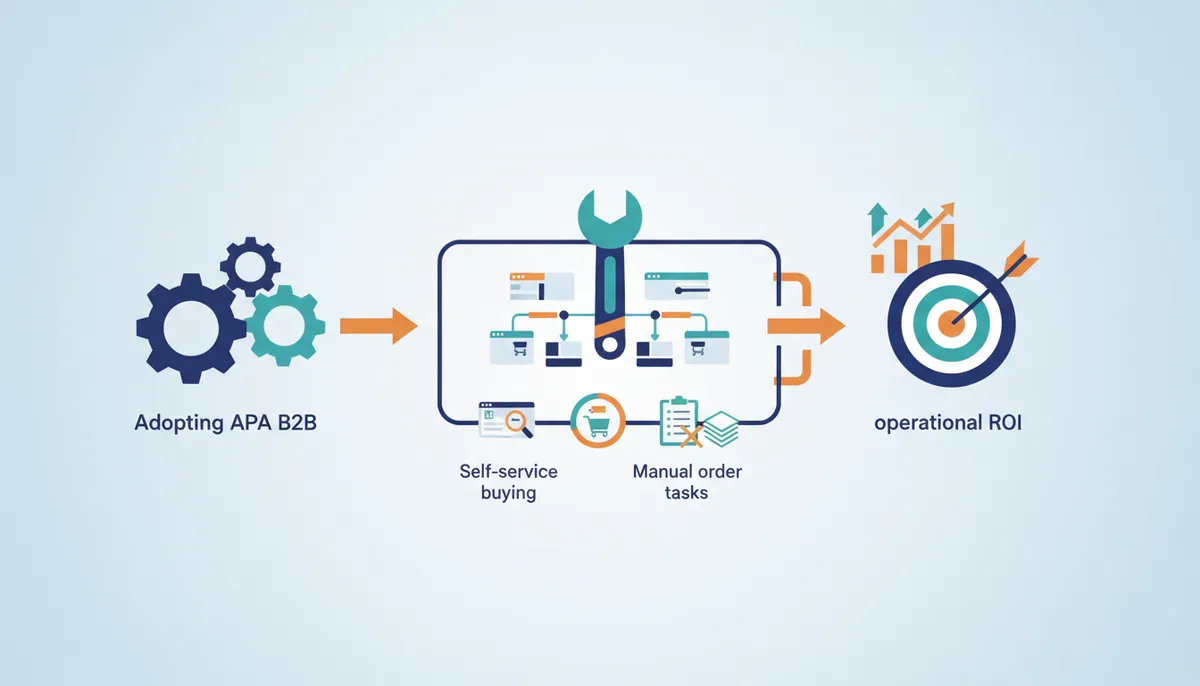
Should you use APA B2B for your catalog if manual exports still corrupt fitment tables? APA states its B2B functions with utmost care to match the purpose of data exportation and maintenance in the easiest manner. This platform serves as critical infrastructure where ERP integration eliminates the fragmentation causing data decay. When systems fail to communicate, businesses struggle to maintain standardized data, directly impacting inventory accuracy.
| Data Risk | Manual Process | Automated Stewardship |
|---|---|---|
| Sync Frequency | Ad-hoc | Nightly or Timely |
| Error Source | Human Entry | System Validation |
| Format Support | Limited | Multi-format FTP |
The Admin Panel enables collaboration between design and sales teams to produce optimal catalogs that aid in increasing sales volume. Unlike static databases, this model supports price customization where levels depending on factors can be decided and updated dynamically. This approach addresses the gap where a majority of marketers lack the correct technology stack to manage content effectively.
- Configure automatic synchronization to run in the nights or on a timely basis.
- Use Bill of Material management to structure complex part relationships.
- Apply Multiple Themes to differentiate wholesale portals from retail storefronts.
Initial setup requires defining strict validation rules before automation begins. However, deploying such autonomy requires rigorous data exportation protocols to prevent fitment errors that could void six-figure orders. A limitation exists where legacy catalogs fail to map competitor numbers accurately, causing buyers to abandon carts despite high digital trust. Operators must configure YMM integration to filter results by vehicle application, reducing return risks on expensive components. The consequence of ignoring this shift is clear: vendors clinging to voice-first workflows will lose the expanding segment of buyers who demand immediate, transparent access to stock import data and tiered pricing structures before they ever pick up a phone.
The Hidden Recurring Costs of Unmanaged Data Volatility
Should you use APA B2B for your catalog if static lists silently erode margin? A database purchased with high accuracy drops significantly within two years without active re-enrichment, forcing teams to pay for verification services repeatedly. This volatility creates a hidden recurring cost that erodes the value of initial procurement. When fitment data drifts, return rates spike, and the cost to rectify a single incorrect shipment often exceeds the profit from the original sale. APA addresses this by functioning with utmost care to match the purpose of data exportation and maintenance in the easiest manner.
Unmanaged decay forces high-value buyers into manual channels they explicitly reject. Since less than half of buyers desire phone contact, inaccurate self-service portals effectively block revenue rather than enable it. Investing in automated synchronization prevents the accuracy drop that turns a premium catalog into a liability.
About
Priya Raman serves as the Aftermarket Category & Supply-Chain Strategist at KZMALL Auto Parts, where she orchestrates the complex intersection of parts data and digital distribution. Her fifteen years of experience managing ACES/PIES fitment standards and B2B catalog governance make her uniquely qualified to analyze B2B e-commerce sites as critical data safekeepers. In her daily work, Priya ensures that KZMALL's platform smoothly integrates with ERP and PMT systems, directly mirroring the article's focus on automated data synchronization and format transfer. She understands that for a global wholesaler managing over 50,000 SKUs, the ability to securely export and maintain vital information a feature but a strategic necessity. By using her expertise in supply-chain economics, Priya connects technical data flows to real-world margin protection, demonstrating how reliable cloud-based architectures empower independent distributors to thrive in a fragmented market.
Conclusion
Scaling B2B ecommerce breaks when data decay silently converts self-service portals into revenue blockers. The operational cost here re-verifying records, but the permanent loss of high-value clients who refuse manual intervention. Once accuracy dips, the platform fails its primary function: enabling trustless, high-volume transactions. You must treat data enrichment as a continuous utility bill rather than a one-time capital expense. Commit to an automated re-enrichment cycle before your catalog accuracy falls below the threshold required for six-figure orders.
Start by auditing your current fitment mappings against live vehicle applications this week to identify immediate drift. Relying on static lists invites margin erosion that outpaces initial savings. The path forward requires integrating YMM integration to ensure every part number matches specific vehicle constraints dynamically. This proactive stance secures the 24/7 availability that modern procurement demands. Vendors who ignore this volatility will find their digital channels clogged with errors, forcing customers back to phone lines they despise. Secure your data pipeline now to maintain the precision required for unlimited deal sizes.
Frequently Asked Questions
Unchecked data decay rapidly reduces database accuracy and reliability. Industry benchmarks show contact data decays at approximately 30% per year without re-enrichment.
Most buyers explicitly demand the ability to manage their own purchasing journey independently. Research indicates a portion of buyers seek these self-service options to avoid phone contact.
The admin panel allows teams to customize price levels based on specific factors. This flexibility supports distinct customer segments while maintaining a single source of truth for all commercial data.
Systems should schedule automatic data transfers during off-peak windows like night cycles. This timing prevents daytime latency while ensuring inventory counts reflect real-world availability for all users.
Effective platforms enable lookups using YMM, VIN, or bill of material structures. These advanced search features increase match accuracy and help mechanics locate parts by identifier quickly.
References