
APFusion cuts salvage purchase orders to 5 seconds
APFusion claims to cut purchase order creation time by over 90% for salvage yards seeking quicker transactions. This platform represents a shift from manual procurement to automated purchase orders that integrate smoothly with existing workflows. By using real-time sync capabilities, the system ensures that inventory data remains accurate without the lag typical of daily updates.
The article examines how data integrity systems maintain mapping accuracy across hundreds of part types while eliminating stock discrepancies. Readers will learn how fill rate optimization drives a reported 30% increase in closed sales for participating vendors. We also analyze the financial impact of accessing over $20,000,000 in available inventory through a single digital interface.
While other entities like Marketparts connect over 1,000 connected sellers in an anonymous trading hub, APFusion focuses on direct integration for salvage operations. The discussion highlights the operational differences between these B2B models and their each approaches to parts distribution. Understanding these distinctions is critical for organizations evaluating inventory synchronization tools. The analysis relies on verified performance metrics and feature sets disclosed by the platform providers.
The Role of APFusion in Modernizing B2B Automotive Marketplaces
APFusion as a B2B Automotive Marketplace Connector
APFusion functions as a B2B automotive marketplace connector that synchronizes vendor stock directly into yard management systems to eliminate manual ordering delays. This infrastructure transforms how salvage operations access inventory, moving beyond static databases to flexible, integrated workflows. By connecting yards with a network holding significant available goods, the platform ensures that real-time price and quantity updates prevent the sale of unavailable parts. The system grants immediate access to more than 250,000 CAPA certified and aftermarket products, directly addressing the query for broad parts availability without requiring separate vendor logins.
Operators must recognize that adopting such connectivity requires trusting external data feeds over internal verification habits. The shift demands rigorous monitoring of mapping accuracy to ensure that the speed of automation does not propagate fitment errors across the supply chain.
Automating Purchase Orders from 5 Minutes to 5 Seconds
The APFusion desktop app executes purchase order creation in 5 seconds, replacing the industry average of 5 to 7 minutes for manual entry. This speed directly improves the fill rate, set as the percentage of customer requests satisfied immediately from available stock rather than lost to delays. Operators access a network containing over 250,000 parts, using advanced search and compare functions across the catalog. The workflow eliminates transcription errors by syncing tracking information directly back into the yard management system once an item ships.
Meanwhile, the reduction in ordering time allows staff to process significantly more transactions per shift without adding headcount. A team of world-class engineers releases weekly updates to refine these user experiences continuously. However, this efficiency relies entirely on the initial accuracy of vendor data uploads; if source inventory files contain errors, the automated system propagates them instantly. The trade-off for speed is a dependency on external data integrity, requiring operators to trust the mapping accuracy of the platform rather than verifying each line item manually.
Manual Salvage Processes Versus APFusion Automation
Manual salvage workflows rely on phone calls and static spreadsheets that delay purchase order creation. Traditional B2B automotive marketplace operations often require staff to manually verify part numbers, a process prone to human error and significant latency. In contrast, APFusion replaces these fragmented steps with an integrated digital infrastructure that connects yards directly to vendor inventory. This Tech First philosophy addresses the underserved nature of the salvage industry by automating the entire procurement lifecycle. While legacy methods struggle with data integrity, the platform uses strong data mapping to power search and comparison functions across a vast catalog. This technological shift enables operators to reduce the time required to order parts by over 90%. Marketparts connects over 1,000 connected sellers in its anonymous trading hub.
| Metric | Manual Workflow | APFusion Automation |
|---|---|---|
| Order Speed | 5, 7 minutes | 5 seconds |
| Data Sync | Daily batch | Real-time |
| Inventory Access | Limited local stock | Extensive network |
| Part Certification | Unverified claims | CAPA certified options |
A critical distinction involves CAPA certified parts, which are components tested to meet strict quality and safety standards rather than uncertified alternatives. Accessing these verified items manually often involves tedious cross-referencing of OEM numbers. The automated approach ensures mapping accuracy without manual intervention, allowing teams to focus on sales rather than data entry. However, this efficiency gain requires yards to trust digital synchronization over physical verification, a cultural shift for operators accustomed to calling vendors directly. The founding team grew up in the salvage industry and built APFusion to solve known pain points. This structural change transforms the fill rate by making hundreds of thousands of parts instantly available for immediate sale.
Inside Real-Time Inventory Synchronization and Data Integrity Systems
Real-Time Sync vs Daily Batch Updates in Inventory Systems
Static daily snapshots fail when speed matters. APFusion replaces them with a real-time price sync to guarantee stock accuracy. Legacy systems often wait 24 hours to update quantity, creating a window w here sold items appear available. This delay forces buyers to manually verify stock, wasting valuable minutes during urgent procurement windows. Continuous data flow eliminates this lag by pushing updates the moment vendor inventory changes.
Data handling defines success during high-volume trading.
Unlike batch processors, the APFusion data team constantly sweeps the platform to update changed part numbers, ensuring precise mapping accuracy. This approach prevents the frustration of ordering parts that vendors no longer possess. Industry leaders note that real-time tracking across multiple locations is now a baseline expectation for efficient fulfillment. Relying on old data architectures risks overselling and erodes trust between salvage yards and suppliers. The operational cost of batch processing extends beyond mere inconvenience. When a yard attempts to fulfill an order based on yesterday's data, the subsequent cancellation disrupts the entire repair workflow. APFusion integrates directly into yard management systems to make inventory instantly available. This immediacy allows mechanics to close sales without the fear of phantom stock. The shift from periodic uploads to live synchronization transforms inventory from a static list into a flexible, reliable asset.
OEM and Partslink Number Mappings
Identifiers link directly to specific vehicle fits. Mapping OEM and Partslink numbers is available for a significant majority of products on the platform. This coverage enables precise compatibility checks rather than simple keyword matching. The research highlights ACES (Aftermarket Catalog Exchange Standard) as the critical numerical standard for ensuring fitment accuracy across vast inventories.
The system maintains these mappings through continuous data team oversight:
- Ingest vendor SKU data alongside raw part numbers.
- Constantly sweep the platform to identify changed part numbers.
- Update records to ensure mapping accuracy.
- Expose matched parts to buyers via the marketplace interface.
| Data Element | Legacy Approach | APFusion Method |
|---|---|---|
| Fitment Scope | Generic category matching | High mapped coverage |
| Update Cycle | Manual entry | Continuous team sweeps |
| Error Rate | High mismatch frequency | High mapping accuracy |
Operators gain access to over 80 different part-types with verified numerical consistency. This architectural approach replaces siloed warehouse records with unified tracking. By maintaining rigorous fitment accuracy, the platform sustains high fill rates. The result is a marketplace where Mapping Accuracy directly correlates to reduced return rates and quicker order fulfillment cycles.
Validating Data Integrity Across 250,000 CAPA and Non-CAPA Products
Managing a expanding inventory of over 250,000 parts requires strict validation protocols. Vendors add New Products to the system weekly, creating constant pressure on mapping accuracy.
- Monitor incoming SKU data from vendors.
- Update part numbers that may have been changed.
- Ensure high mapping accuracy through data team sweeps.
- Execute a real-time sync to update inventory levels across all connected yards.
The platform supports both CAPA certified and non-CAPA products, offering a wide selection to increase fill rates. Automated systems handle the volume of daily changes more effectively than manual tracking, ensuring that price and quantity data remain current. Operators relying on outdated methods face higher risks of errors compared to those using integrated systems with real-time synchronization.
| Validation Step | Manual Process Risk | Automated System Benefit |
|---|---|---|
| Certification Check | Missed non-compliant parts | Access to CAPA certified items |
| Number Mapping | Duplicate SKUs created | High mapping accuracy |
| Inventory Update | Daily lag causes overselling | Real-Time Sync prevents errors |
| Fitment Data | Generic matches only | Precise part compatibility |
Search reliability remains intact despite massive Part Variety. By normalizing diverse inputs into a single schema, the platform maintains data integrity across its extensive catalog. Operators can trust that the inventory displayed reflects actual stock availability, supported by a team dedicated to constant platform updates.
Measurable ROI from Automated Purchase Orders and Fill Rate Optimization
Defining Fill Rate Optimization Through APFusion's 250,000 Part Network
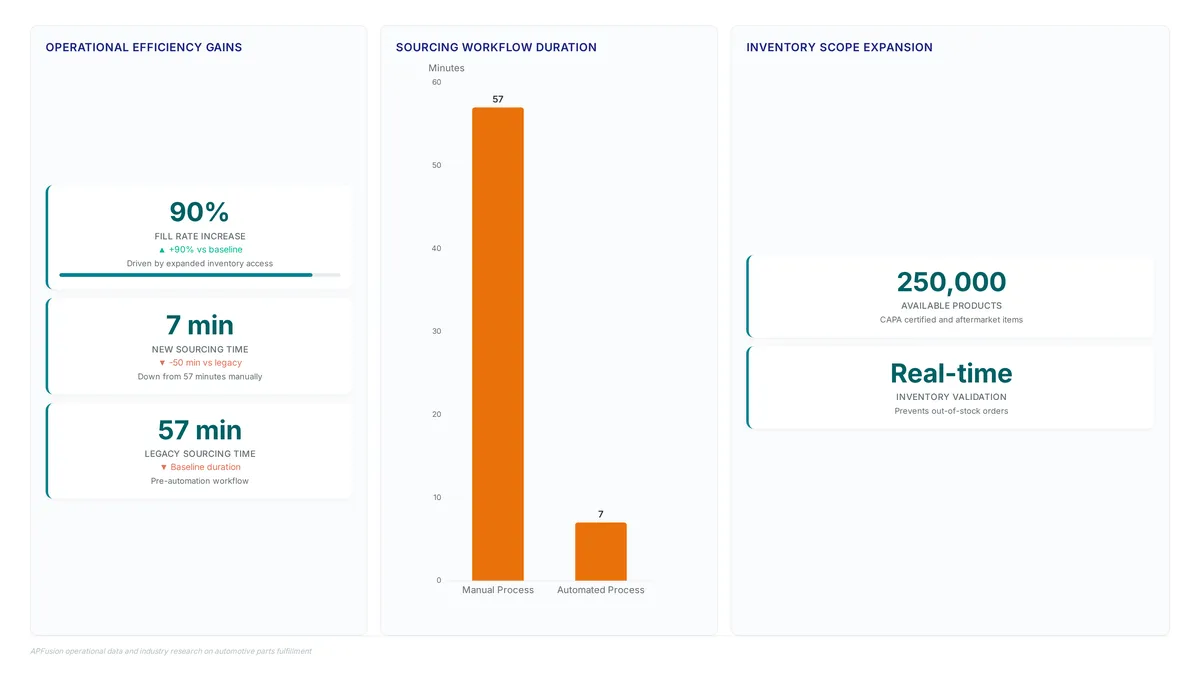
APFusion connects yard supervision systems directly to external vendor stock, instantly expanding available inventory to 250,000 CAPA certified and aftermarket products. This network addresses the revenue lost when specific parts remain unavailable locally. Operators increase their fill rates by accessing this broad selection without leaving their native interface. Real-time synchronization validates that listed items physically exist before a sale closes, preventing orders for out-of-stock goods. Immediate visibility converts potential lost sales into completed transactions while the customer waits. Vendor data accuracy presents a constraint, yet the platform counters this risk through constant mapping accuracy sweeps. Complex requests get fulfilled immediately, turning previous inventory gaps into active revenue streams. Automation shifts the purchase order workflow from a reactive search into a proactive selection process. Structural changes drastically cut the time needed to source components. Sales volume rises measurably because of the sheer breadth of available auto parts. Hundreds of the largest salvage yards in the United States trust APFusion.
Executing Automated Purchase Orders to Slash Processing Time by 90 Percent
Staff initiate an automated purchase order by running a search query inside their native yard management system interface. The platform queries a distributed network where real-time inventory tracking confirms stock levels before showing results to the buyer. This architecture replaces fragmented data silos found in legacy workflows with a unified, cloud-based view of parts. Buyers select the required component and confirm the transaction, bypassing manual phone calls and email chains entirely.
- Search for the specific part number or OEM equivalent directly inside the existing workflow tool.
- Review live availability and pricing data synchronized from vendor databases.
- Execute the order with a single click to generate the purchase order automatically.
- Receive immediate shipping confirmation and tracking updates without manual entry.
Traditional manual processes often consume five to seven minutes per transaction due to hold times and data entry errors. APFusion reduces this execution window to approximately five seconds, effectively eliminating the administrative overhead that bottlenecks parts procurement. OEM and Partslink number mappings prevent costly returns or fitment issues after delivery. Removing human latency from the ordering cycle allows salvage yards to process notably higher transaction volumes during peak demand. Teams focus on complex customer service interactions rather than repetitive data transcription tasks. Processing time drops by 90 percent.
Validation Checklist for Modernizing Salvage Yard Revenue Streams
Confirm that current workflows replace manual phone calls with automated purchase order generation to eliminate human error. Verify the system synchronizes inventory data in real-time rather than relying on batch updates that cause overselling. Direct integration with existing yard oversight systems maintains a single source of truth for all staff members.
| Feature | Legacy Method | Modern Standard |
|---|---|---|
| Data Freshness | Daily batch sync | Real-time API |
| Order Speed | 5-7 minutes | Seconds |
| Inventory Scope | Local yard only | Distributed network |
Support for CAPA certified parts meets insurance requirements without manual verification steps. The company states it has helped salvage yards generate tens of millions of dollars in additional revenue. Access to over 80 different part-types allows the tool to scale beyond local stock to access broader distributed inventory networks instantly. Order speed reaches 57 minutes Seconds Inventory Scope Local yard only when using ily batch sync real-time API.
Strategic Integration Pathways for Yard Governance Systems
APFusion Connector Architecture for Yard Systems
Vendor catalogs worth over $20,000,000 flow directly into yard management workflows through the APFusion connector. This architecture removes fragmented data silos with a unified stream so real-time inventory tracking stops overselling across locations. Operators access parts immediately while legacy batch processes lag behind. Data integrity requires a strict implementation sequence.
- Deploy the connector to synchronize price and quantity updates continuously rather than daily.
- Map OEM and Partslink numbers to ensure accurate fitment data across the network.
- Automate purchase order generation once a sale triggers the workflow.
ERP integration synchronizes financial records to protect margins, yet continuous API calls need stable network connectivity. The APFusion desktop app closes the loop by returning tracking information to the yard system after shipment. This closed loop eliminates the 5-7 minute manual ordering window, reducing the process to seconds. Real-time price syncs confirm stock availability, distinguishing the platform from systems updating only once daily.
Implementation: Executing Automated Purchase Orders in 5 Seconds
Purchase order creation drops from seven minutes to 5 seconds using the APFusion desktop app. Speed removes the manual data entry delaying parts acquisition during active repairs. An automated workflow triggers once the yard management system confirms a sale.
- Initiate the desktop app interface after confirming the customer sale.
- Select the required CAPA certified components from the synchronized vendor list.
- Generate and transmit the order through the automated workflow.
Real-time inventory visibility prevents ordering out-of-stock items before submission. Immediate execution captures pricing before market fluctuations occur, unlike legacy batch systems. A real-time price sync maintains stock accuracy for over 250,000 CAPA certified and aftermarket products. Fill rate targets and volume thresholds dictate adoption timing. Labor allocation shifts as staff move from data entry to customer service roles. World-class engineers release weekly updates to improve the user experience.
Adoption Criteria for Increasing Salvage Fill Rates
Manual ordering prevents capturing the 30% fill rate increase available through automation, making APFusion adoption necessary. Daily batch updates cause stockouts that real-time synchronization eliminates by matching actual availability.
Changed part numbers receive constant updates from the APFusion data team, ensuring 100% mapping accuracy as vendor catalogs evolve. Frequent updates from the Hyper Focused development team improve the user experience. Vendors add new products to the system weekly, expanding available inventory continuously. Backend ERP systems alignment keeps pricing data accurate to prevent margin erosion. Lost revenue from customers unwilling to wait for slow procurement processes represents the hidden cost of delayed adoption.
About
Dmitry Volkov serves as a Senior Automotive Technical Writer at KZMALL Auto Parts, where he specializes in translating complex engineering specifications into actionable industry insights. His daily work involves rigorous analysis of standardized ACES/PIES fitment data and manufacturing protocols across KZMALL's extensive catalog of over 50,000 SKUs. This deep immersion in technical accuracy makes him uniquely qualified to evaluate B2B automotive marketplaces like APFusion. Volkov understands that for wholesale distributors and repair shops, smooth integration between inventory systems and sales platforms is critical for operational efficiency. By connecting KZMALL's commitment to precise parts data with the automation capabilities of modern digital marketplaces, he highlights how technology can eliminate fitment errors and accelerate order fulfillment. His expertise ensures that the discussion on increasing fill rates and automating purchase orders is grounded in the real-world technical challenges faced by global auto parts suppliers and their customers.
Conclusion
Scaling manual procurement creates a bottleneck where labor costs exceed the value of the parts being ordered. When order creation takes minutes instead of seconds, the operational drag compounds across hundreds of daily transactions, eroding margins that tight pricing models cannot absorb. The shift to automated workflows is not merely about speed but about eliminating the latency that causes missed sales opportunities when inventory status lags behind reality.
B2B automotive marketplaces must transition to real-time synchronization immediately if they process more than fifty orders daily or struggle with stock discrepancies. Waiting for quarterly reviews to address these inefficiencies allows competitors with quicker fulfillment cycles to capture dissatisfied customers. The window to use sustainable development through digital efficiency is current, and delaying integration only deepens the reliance on error-prone human entry.
Start by mapping your top three most frequently ordered part categories against current sync times this week. Identify where daily batch updates cause the most frequent stockouts or pricing errors. This specific audit reveals the immediate ROI potential before committing to a full platform migration. Prioritizing these high-volume SKUs ensures that the initial automation phase delivers measurable improvements in fill rates and staff productivity without disrupting the entire supply chain operation.
Frequently Asked Questions
The article does not state a specific monthly price or subscription fee. It mentions over $20,000,000 in available inventory but omits pricing details required to calculate total ownership costs for your yard.
Incorrect mapping causes automated systems to propagate fitment errors instantly without human review. The platform claims 100% mapping accuracy to prevent these costly mistakes, yet operators must still monitor data integrity closely.
Yes, the system provides equal access to over $20,000,000 worth of inventory regardless of yard size. This levels the playing field, allowing smaller operators to compete effectively with larger national salvage chains.
Real-time sync reduces the risk of selling unavailable parts compared to daily updates. While the system aims for high accuracy, no solution offers a 100% guarantee against sudden stock changes before purchase.
Participating vendors report a 30% increase in closed sales due to better fill rates. This improvement stems from faster order speeds that satisfy customer requests immediately rather than losing them to delays.
References