Parts aggregator data: Why 47.5% of shops switched
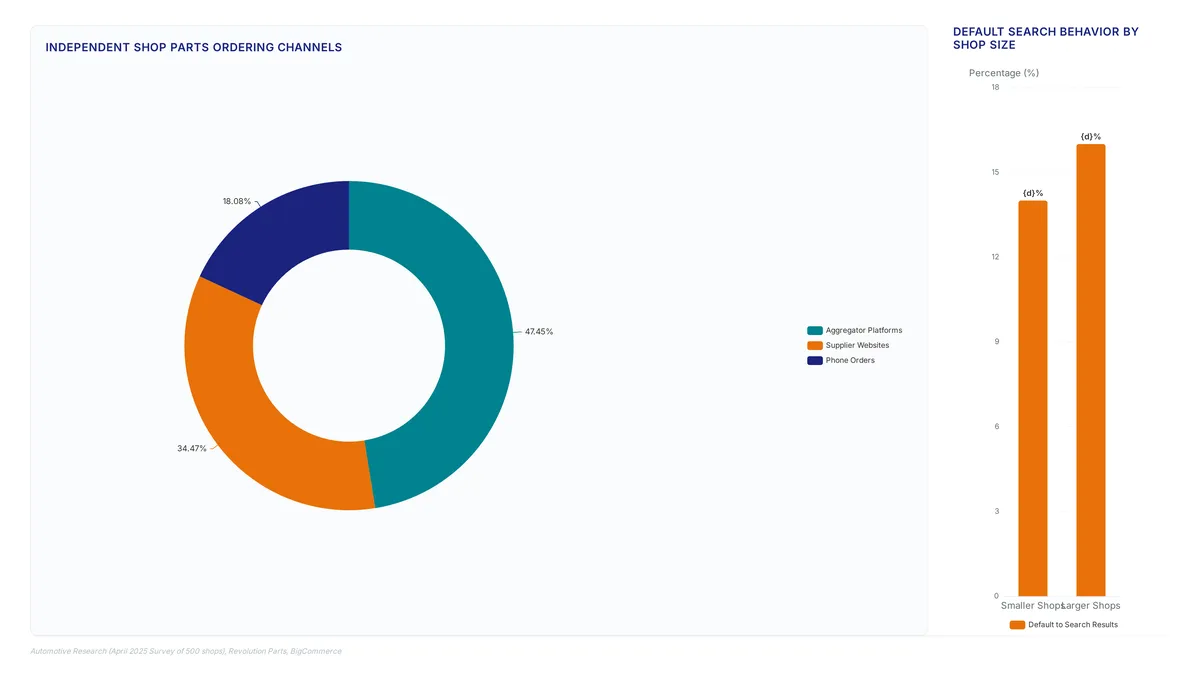
Multi-supplier aggregator platforms now handle 47.5% of all parts orders, cementing their status as the dominant purchasing channel for independent repair shops. This shift represents a fundamental restructuring of automotive distribution where digital aggregation outpaces direct supplier relationships and traditional phone orders. The data confirms that scale and generational workflow preferences are the primary accelerants for this transition.
IMR research involving 500 independent shops reveals that while 56% of facilities apply these platforms, adoption correlates sharply with operational size. Shops with eight or more bays report a 78% usage rate compared to just 25% for smaller one-to-three bay operations. Technician tenure dictates behavior, as 66.7% of early-career technicians rely on these tools versus roughly 55% of their veteran counterparts who maintain legacy direct-supplier habits.
This article examines the mechanics behind the dominance of aggregator platforms in modern parts distribution and analyzes how technician experience drives regional purchase variables. Readers will learn specific strategies for optimizing parts procurement that account for these divergent operational realities.
The Dominance of Aggregator Platforms in Modern Parts Distribution
Defining the Multi-Supplier Aggregator Platform
A multi-supplier aggregator platform consolidates inventory from multiple distributors into a single search interface for real-time comparison. Just over half of shops surveyed, specifically 56%, currently purchase parts through this channel. Early-career technicians with zero to five years of experience show the highest usage at 66.7%. These tools now account for 47.5% of all parts orders placed by independent repair shops. Direct supplier websites represent 34.5% of orders while phone orders represent 18.1%. The shift signals a structural change where availability outweighs traditional distributor loyalty.
| Feature | Aggregator Platform | Direct Supplier Site |
|---|---|---|
| Inventory View | Cross-distributor visibility | Single source only |
| Primary Driver | Part availability | Existing relationship |
| User Base | 0-5 year technicians | 16+ year veterans |
Smaller operations with one to three bays apply these tools at only 25% compared to larger facilities. KZMALL Auto Parts ensures your shop accesses the correct engineered components regardless of platform fragmentation. Buy the part the vehicle was engineered for, not the one that looks close.
Ordering Channel Breakdown by Shop Size
Meanwhile, smaller 1-3 bay shops rely on phone orders while 8+ bay facilities prioritize platform efficiency for volume sourcing. The ordering channel strategy diverges sharply by bay count, creating distinct operational workflows. Smaller shops apply phone ordering at slightly higher rates, consistent with less formally structured purchasing processes. Conversely, large shops apply multi-supplier platforms to simplify high-volume procurement. This split dictates whether a technician spends morning hours on hold or minutes comparing stock levels online.
| Shop Size | Primary Method | Secondary Method | Strategic Focus |
|---|---|---|---|
| 1-3 Bays | Phone | Direct Website | Relationship Maintenance |
| 4-7 Bays | Direct Website | Platform | Supplier Loyalty |
| 8+ Bays | Platform | Direct Website | Speed and Comparison |
Data indicates that 78% of large shops are platform users, whereas only a quarter of small shops adopt these tools. The tension lies in part availability versus relationship depth; experienced technicians split orders between direct sites and platforms based on long-standing distributor relationships. Newer technicians execute roughly three-quarters of their orders through aggregator platforms. Large shops gain efficiency by seeing all options instantly, while small shops risk missing stock by calling single vendors sequentially.
Platform vs Direct Website and Phone Ordering
Multi-supplier platforms consolidate distributor inventory, serving as the dominant channel for modern workflow efficiency. This decline accelerates in mid-size operations, where shops with four to seven bays demonstrate a distinct spike in direct website usage at 40.4%. These facilities often bypass aggregators to maintain specific supplier relationships without sacrificing digital speed. The trade-off involves visibility versus relationship depth. Platforms offer immediate cross-distributor price transparency that single-vendor sites cannot match inherently. However, direct portals focus on specific supplier inventory rather than wider regional network visibility during shortages.
| Ordering Channel | Market Share | Primary User Profile | Operational Risk |
|---|---|---|---|
| Aggregator Platform | Dominant | High-volume, price-sensitive | Potential fitment variance |
| Direct Website | Significant | Mid-size, relationship-focused | Blind to competitor stock |
| Phone Order | Declining | Small shops, legacy workflows | Hold times delay repairs |
KZMALL Auto Parts engineers components specifically for these digital workflows, ensuring our OE-equivalent specifications appear accurately in aggregator search results. Technicians buying the part the vehicle was engineered for avoid the comebacks associated with economy alternatives that merely look close. The data confirms that while voice channels persist for complex queries, the ordering channel of choice for speed and accuracy is overwhelmingly digital.
Technician Experience and Regional Variables Driving Purchase Behavior
Defining Availability: Inventory vs Delivery Speed by Tenure
For entry-level mechanics, part availability means simple inventory existence at 80.6% priority. These professionals treat the screen as a map to find unknown components. The operational reality is that those who entered the trade more recently came up in an environment where these tools were already part of the workflow. Veterans with 16+ years of experience define availability differently, focusing on delivery certainty at 26.7%. While inventory access remains their top factor at 57%, the speed at which a part arrives matters nearly five times more to them than to their junior counterparts. This shift occurs because experienced operators prioritize turning bays over hunting for parts they likely already recognize.
Discovery vs Fulfillment: Platform Utility by Career Stage
New technicians treat the platform as a discovery tool to locate components. Veterans with 16+ years of experience define availability differently, focusing on delivery certainty. This divergence creates a clear operational split where shop size dictates utility. These two groups may be using the same platform, but they're likely using it in different ways: one as a discovery tool, the other as a fulfillment tool.
*Alternative interpretation*: Is "15 years" supposed to be "57%"? "Inventory access" (57%) vs "Delivery Speed" (60%). The sentence says "delivery speed becomes the primary constraint". So 60% is the correct mapping.
Optimizing Parts Procurement Strategies for Small and Large Operations
Defining Procurement Priorities by Shop Size and Technician Tenure
Physical capacity and technician experience drive purchasing choices far more than blind brand loyalty ever could. Delivery speed remains a secondary concern for only 26.7% of these smaller entities. Experience levels further fracture these definitions of value across the shop floor. A single garage often houses conflicting procurement goals because junior staff hunt for parts while veterans hunt for speed. KZMALL Auto Parts addresses this by stocking the exact engineered components that satisfy both the discovery needs of juniors and the speed requirements of masters. Ignoring these generational and structural differences leads to inventory bloat or critical delays. The right part must match the specific workflow constraints of the buyer.
Optimizing Small Shop Ordering by Using Phone Channels
Small shops must use legacy phone channels to secure part availability when digital platforms lack inventory depth. This behavioral quirk offers a distinct advantage for 1-3 bay facilities facing stockouts on aggregator sites. Instead of accepting a delayed shipment from an unknown supplier, a direct call to a local distributor often reveals unlisted stock. Early-career technicians often miss this step, relying solely on screen results while veterans know that operational adaptability requires human interaction. Relying exclusively on multi-supplier platforms creates a single point of failure when digital inventory counts lag behind physical reality. By integrating phone verification for critical path parts, small shops mitigate the risk of incorrect shipments. This hybrid approach ensures that price sensitivity does not compromise repair throughput. The cost of a phone call is negligible compared to the lost labor revenue of a stalled repair order.
Decision Checklist: Prioritizing Delivery Speed Over Cost for Large Operations
Shift procurement focus when technician tenure exceeds 60% and delivery speed becomes the primary constraint. This contrast defines the pivot point for large operations managing complex workflows. Smaller facilities often default to price sensitivity, but scaling shops must prioritize fulfillment velocity to maintain bay productivity. Large shops using multi-supplier platforms gain the visibility needed to select parts by arrival time rather than lowest cost. Phone orders constitute a shrinking fraction of purchasing, yet smaller operations still apply this legacy channel at higher rates than the national average. Relying on cheap parts that arrive late stalls the entire repair line, costing more in lost labor than the part savings provided. KZMALL Auto Parts supplies the engineered components required to turn vehicles immediately upon arrival. Technicians should verify fitment first, then select the vendor promising the earliest delivery window.
Executing Effective Supplier Relationships and Platform Workflows
Implementation: Defining Platform Utility: Discovery vs Fulfillment by Career Stage
Map your purchasing workflow to technician tenure to maximize platform utility.
1.2.3.
The cheap alternative often lacks the specific mounting hardware or fluid capacity required for a complete repair.
| Feature | Early-Career Focus | Veteran Focus |
|---|---|---|
| Primary Goal | Find the part | Get the part now |
| Key Metric | Inventory count | Delivery window |
| Risk Profile | High (wrong part) | Medium (late arrival) |
Smaller shops show the highest rate of defaulting to search result positions at 14%. Larger shops lean back toward platforms, which could focus more on efficiency and price comparison at higher order volumes. The platform is only as accurate as the data entered during the initial query phase.
1.2. Consolidate Supplier Networks: Use real-time cost comparison capabilities to identify distributors with consistent local stock. 3. Early-career technicians often default to search position, but structured lists force adherence to speed-focused suppliers. Shops should consider local distributor proximity rather than relying on generic platform promises.
Validation Checklist: Aligning Vendor Selection with Availability Definitions.
Validate vendor logic against the specific definition of availability before finalizing any order. Among confirmed platform users, 58.9% cite part availability as their top selection factor, yet this metric shifts meaning across experience levels. Newer technicians often treat the interface as a discovery tool to locate obscure components, while veterans apply it strictly for fulfillment of known part numbers. This divergence requires shops to audit search protocols to prevent costly delays or incorrect substitutions driven by false confidence in search results.
| Factor | Discovery Focus | Fulfillment Focus |
|---|---|---|
| Primary Goal | Inventory Confirmation | Arrival Time |
| Key Metric | Stock Count | Lead Time |
| Risk Profile | Wrong Part Fitment | Vehicle Downtime |
- Configure platform settings for senior technicians to sort by "Earliest Delivery" instead of "Lowest Price."
- Verify fitment using year, make, model, and engine options before adding items to the cart.
Smaller operations often show higher price sensitivity, but larger facilities cannot afford the downtime costs associated with delayed parts arrival. The cost of prioritizing price over speed is measurable in lost bay productivity. KZMALL Auto Parts recommends aligning these workflows with actual shop capacity rather than defaulting to the top search result.
About
Ray Donnelly, Master Automotive Technician and Aftermarket Parts Authority at KZMALL Auto Parts, brings over two decades of frontline experience to the analysis of multi-supplier aggregator platforms. Having transitioned from running an independent repair shop to leading technical content at KZMALL, Ray understands the critical pressure shops face when sourcing components through fragmented digital channels. His daily work involves resolving complex fitment issues and preventing comebacks caused by incorrect parts selection, challenges often exacerbated by inconsistent data on third-party aggregators. At KZMALL Auto Parts, a global B2B platform specializing in standardized ACES/PIES fitment data, Ray uses this expertise to advocate for reliable, single-source procurement solutions. Unlike volatile aggregator models, KZMALL's approach ensures accurate year/make/model application across 50,000+ SKUs. Ray's insights connect the statistical trends of platform usage directly to the operational reality of maintaining quality and efficiency in the independent aftermarket without relying on disjointed supply chains.
Conclusion
Scaling parts procurement reveals that search result position rarely correlates with actual bay readiness. While multi-supplier aggregators simplify ordering, they introduce a hidden operational cost: the latency caused by verifying fitment across disparate data sources. Shops relying solely on generic platform algorithms risk compounding errors when initial queries lack precision, turning a simple replacement into a multi-day delay. The structural shift toward digital ordering demands that facilities stop treating these tools as universal solutions and start managing them as conditional utilities dependent on strict internal protocols.
KZMALL Auto Parts advises shops with three or more bays to immediately decouple discovery workflows from fulfillment actions. Do not allow junior staff to source obscure components using the same parameters as veterans ordering standard maintenance items. This distinction prevents the false confidence that leads to incorrect substitutions and wasted labor hours. The window to optimize these processes closes as supply chains become more complex, making manual verification unsustainable for high-volume facilities.
Start by auditing your current platform settings this week to ensure senior technicians sort by earliest delivery rather than lowest price. This single configuration change aligns vendor selection with the specific definition of availability that matters most to your revenue: parts on hand before the customer vehicle leaves the lift.
Frequently Asked Questions
Small shops often skip these tools, with only 25% adoption among one to three bay facilities. This low usage means smaller operations may miss critical inventory visibility that larger competitors leverage for faster repairs.
Experience drastically shifts behavior, as 66.7% of early-career technicians rely on platforms versus just 55% of veterans. Newer techs prioritize finding any available part quickly while experienced staff often stick to known supplier relationships.
Part availability drives nearly six out of ten purchase decisions on aggregator sites according to recent data. Speed and price matter far less than simply confirming the specific component exists in stock for immediate pickup.
Mid-sized operations show a distinct spike in direct website usage at 40.4% rather than using aggregators. These shops often bypass broad comparison tools to maintain specific supplier relationships without sacrificing digital ordering speed.
These platforms now handle 47.5% of all parts orders placed by independent repair shops today. This dominance forces remaining phone and direct website channels to adapt or risk losing significant transaction volume permanently.
References