
AAPEX 2026 Strategy: Navigating 1,400 Categories
Only 3% of technicians can service an EV. That statistic alone turns AAPEX 2026 from a trade show into a triage center for the industry's workforce proficiency crisis.
Forget the spectacle. The event functions as a mandatory convergence point to solve a specific problem: we cannot service the modern fleet. The programming attacks this gap directly with hands-on EV service training at Joe's Garage. Organizers have reconfigured the 550,000 square foot floor to streamline access to the 1,400 product categories independent shops desperately need to combat parts scarcity.
New this year is iFlex at AAPEX, a zone carved out for quick-lube operators facing a surge in preventative maintenance demands. Beyond the exhibit hall, the AAPEX Forum hosts general sessions where leaders debate business model viability against spiraling operational costs. You will see how student competition pipelines can plug staffing holes while you evaluate new suppliers across 5,500 booths. The agenda strips away the fluff, forcing the 2,500 exhibitors to present solutions, not just brochures. By locking onto diagnostics and ADAS integration, the show demands a pragmatic approach to the $2.3-trillion global aftermarket's most glaring technical deficits.
The Strategic Role of AAPEX 2026 in the Global Automotive Aftermarket
AAPEX 2026: The $2.3-Trillion Aftermarket's Core B2B Tradeshow
AAPEX 2026 is the primary B2B nexus for the $2.3‑trillion global automotive aftermarket. It operates as a transaction engine, not a consumer spectacle. Co-produced by the Auto Care Association and MEMA Aftermarket Suppliers, the event isolates supply-chain mechanics from retail marketing noise. This separation ensures the 2026 theme, "where the industry gets real," drives contract execution rather than vanity metrics.
The operational scope covers 550,000 square feet of exhibit space, organizing over 1,400 product categories for bulk procurement. Unlike general industry gatherings, this forum leverages Joint Channel Forecast data to align manufacturer output with distributor inventory models. Exclusivity is the filter here; general public access is prohibited to maintain a high-density professional environment. Network effects compound specifically around wholesale pricing tiers and logistical interoperability.
Strategic participation requires navigating tiered registration costs starting at $50 before rising to $75 and finally $100. Early commitment secures access to the iFlex section, a new zone dedicated to quick-lube operators and preventative maintenance technologies. Ignoring the early registration window forces operators into higher cost brackets while reducing booth selection quality. As vehicle ages increase, the market demands this precision, requiring specialized parts that only dedicated B2B channels reliably stock.
Realizing Business Goals: Networking Across 120 Countries at Venetian Expo
Professionals from 120 nations apply the 550,000 square feet of exhibit space to execute contracts, not merely browse. The event transforms the Venetian Expo into a functional marketplace where MEMA Aftermarket Suppliers members secure distribution channels amid rising shop consolidation. This structural shift moves the industry away from fragmented DIY models toward professionalized service ecosystems. Attendees use the venue to navigate these changes, sourcing products that address the needs of an aging vehicle fleet.
The Auto Care Association enables this by uniting retailers, distributors, and manufacturers under one roof. This unified approach provides the data necessary to forecast growth in a market projected to reach $804.82 billion by 2029. Operators attending the show gain direct access to supply chains that support this expanding valuation.
Key operational objectives met on the floor include:
- Sourcing components for vehicles exceeding 13 years of age.
- Establishing direct lines with manufacturers to bypass intermediaries.
- Evaluating new technologies for independent repair shops.
- Securing long-term supply agreements before Q4 inventory builds.
- Analyzing competitive positioning against OEM regulatory burdens.
The sheer density of 2,500 exhibitors creates a high-efficiency environment for deal-making. However, the volume requires strategic navigation to avoid redundant vendor meetings. Successful participants pre-plan booth visits to maximize the value of their time in Las Vegas.
Strategic Registration Deadlines: Securing Access Before Sept. 25, 2025
Missing the Sept. 25, 2025 early deadline forces buyers to pay double the base fee for identical AAPEX 2026 floor access.
Sept. 25, 2025: a significant price increase. Final Post-Sept. 25: a complete price increase.
Delaying registration creates a direct conflict with capital allocation for technician training, where shops already face severe budget pressure from EV upskilling costs. The $30,000 total saved by a ten-person team registering early directly offsets the vacancy cost of unfilled technical roles. Independent suppliers must also consider how registration timing impacts their ability to compete against OEMs bearing high regulatory compliance expenses. Late fees reduce the budget available for navigating these complex market shifts.
Operators treating registration as an administrative afterthought effectively burn capital that could secure critical supply chain advantages. The financial penalty for missing the first window is absolute.
Operational Mechanics of Sourcing and Education at the Venetian Expo
Defining iFlex at AAPEX and the Joe's Garage Training Hub
AAPEX 2026 deploys iFlex at AAPEX as a dedicated zone for quick lube operators, isolating preventive maintenance supply chains from general aftermarket noise. This segmentation addresses the specific inventory velocity required by high-turnover service bays. The structural separation allows Preventive Automotive Maintenance Association 2--in-2026) members to bypass broadline distributor bottlenecks. However, this specialization creates a dependency on accurate parts forecasting that many small shops lack. Joe's Garage counters this skills gap by providing hands-on diagnostic training for ADAS and EV systems. Current data indicates only 3% of technicians possess EV proficiency, creating a vacancy cost of $60,000 per month for each unfilled role. The training curriculum directly targets this deficit through practical modules on workforce development.
| Feature | iFlex Section | Joe's Garage |
|---|---|---|
| Primary Focus | Preventive Maintenance Supply | Technical Skills Acquisition |
| Target Audience | Quick Lube Operators | Service Technicians |
| Key Metric | Inventory Turnover | Technician Certification Rate |
| Technology Scope | Fluids, Filters, Wipers | ADAS, EV, Diagnostics |
The limitation remains scale; classroom capacity cannot match the 51% of firms adopting AI workflows simultaneously. Operators must prioritize which technology stack receives immediate human capital investment. Without this triage, shops risk overspending on unused certifications while underutilizing automated diagnostic tools. The convergence of specialized sourcing and urgent upskilling defines the operational reality for 2026 attendees. Success requires executing both procurement and education strategies within the tight window of the expo.
Student Competition Mechanics and Free Mini Stage Sessions
Aspiring technicians enter the second annual student competition to demonstrate practical skills before industry judges. This event targets the critical shortage where only a fraction of the workforce possesses electric vehicle maintenance proficiency. Accessing free education requires navigating specific zones rather than general admission areas.
- Locate Mini stages scattered across the show floor for impromptu debates.
- Visit Joe's Garage for structured hands-on diagnostics training.
- Attend sessions focused on ADAS calibration and shop management workflows.
The Auto Care Association supports this pipeline by dedicating resources to advancing industry knowledge through such competitions. While the Mini stages offer immediate tactical value, the student competition provides long-term career validation. A tension exists between broad exposure and deep specialization; students spreading time across too many demos may miss the focused repetition needed for mastery.
| Feature | Location Type | Primary Outcome |
|---|---|---|
| Debates | Mini stages | Rapid knowledge exchange |
| Diagnostics | Joe's Garage | Hands-on skill verification |
| Networking | General Floor | Relationship building |
Operators should note that Joe's Garage capacity remains limited compared to open-floor traffic. Registrants must prioritize high-value technical blocks over passive observation to offset rising vehicle data. The structural separation of these learning hubs prevents dilution of technical content by general marketing noise.
Sourcing Success Checklist: Navigating 1,400 Product Categories
Navigating 1,400 product categories requires filtering suppliers by ACES and PIES compliance to guarantee fitment data accuracy. Last year, 86 per cent of attendees met discovery objectives, yet independent shops often miss the OEM vs. Independent margin divergence on EV components.
| Feature | General Floor | iFlex Zone |
|---|---|---|
| Target Audience | Broad Distributors | Quick Lube Operators |
| Data Standard | Variable | High Velocity |
| Training Focus | General Diagnostics | Preventive Maintenance |
- Prioritize booths displaying April 2026 data standard readiness.
- Isolate iFlex at AAPEX for high-turnover inventory sourcing.
- Validate supplier claims against General Motors quality scan compatibility.
While 81 per cent successfully evaluated new partners, relying solely on general exhibits ignores the specialized supply chain needs of modern quick-lube models. The Joe's Garage training hub offers a secondary verification layer where product durability is tested against real diagnostic scenarios. Operators who skip this technical validation face higher return rates when vehicle software updates alter part specifications. Sourcing success now depends on verifying digital interoperability before physical stock arrives at the warehouse. Teams delaying entry face capital conflicts similar to unplanned grid upgrades that spike operational budgets unexpectedly. 1.2.3. The financial penalty for missing the June date mirrors the volatility seen in battery energy storage systems, where component costs fluctuate based on supply chain timing. Operators must treat these deadlines as hard technical constraints rather than soft suggestions. Failure to adhere results in a 50 percent price increase that drains resources from critical technician training initiatives. The cost structure demands precise calendar alignment to avoid wasting capital on avoidable fees.
Booking onPeak Housing and Qualifying for Media Passes
Securing lodging requires immediate action through onPeak, the official housing partner managing room blocks for the Venetian Expo. Delaying this step risks missing shuttle availability as inventory depletes rapidly near the event dates. Operators should prioritize this logistical anchor before finalizing travel budgets to avoid premium rates.
- Access the dedicated onPeak portal linked from the main event site.
- Select room categories matching your team size and budget constraints.
- Confirm reservation details to lock in official event rates.
- Verify shuttle schedule alignment with your daily agenda.
Media professionals and vocational students bypass standard fees but face strict eligibility verification.
Business Value Realization Through Network Expansion and Technology Adoption
Quantifying Supplier Discovery Success Rates at AAPEX
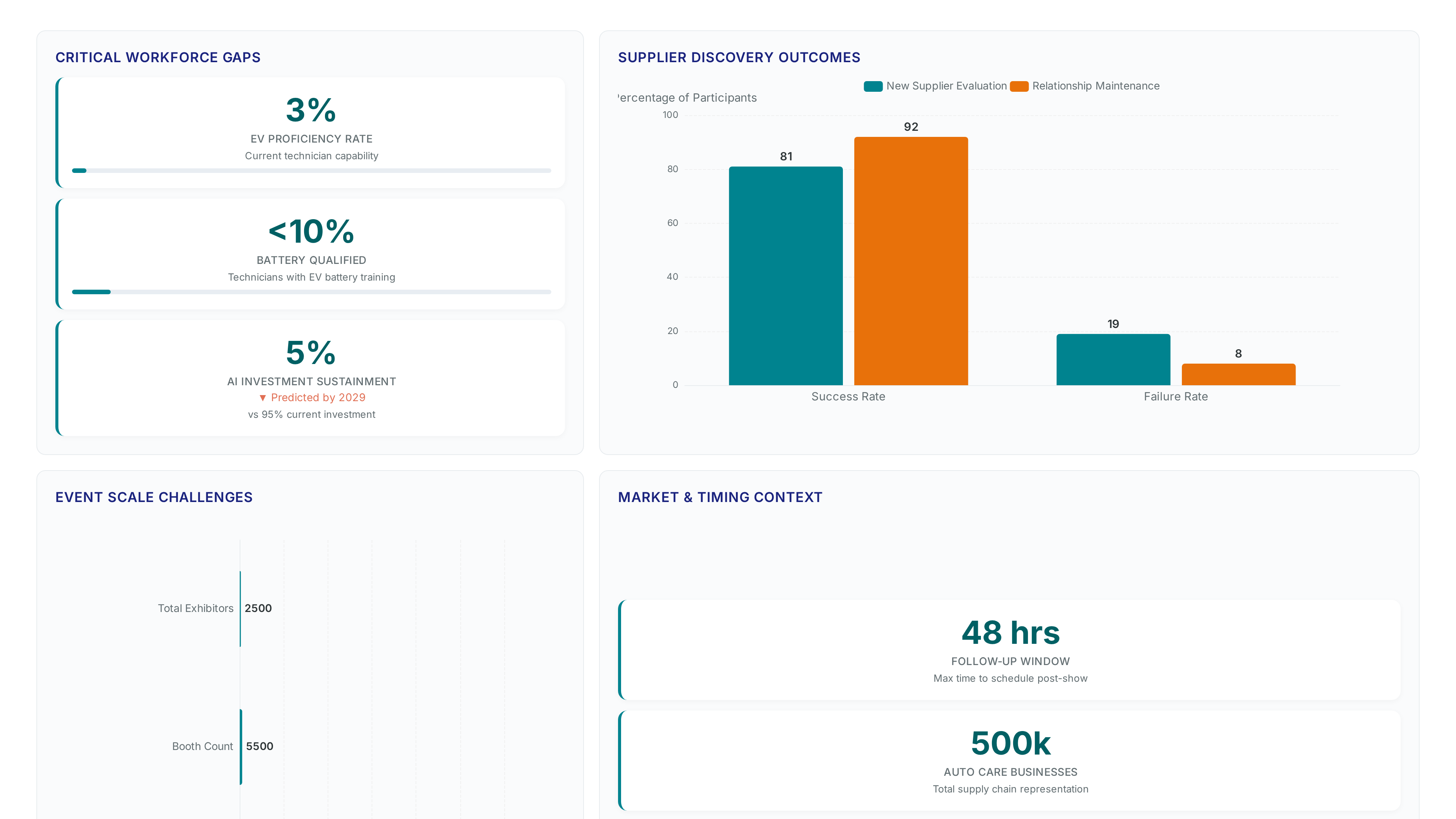
Historical survey data from 906 participants shows 81 per cent successfully evaluated new suppliers, establishing a high baseline for ROI. This probability of success relies on navigating the Joint Channel Forecast 2--in-2026) dynamics where supply chains are consolidating. Independent shops face distinct pressure compared to OEM-aligned entities, as independent suppliers pass costs upstream to maintain margins. The remaining 19 per cent failure rate often stems from inadequate preparation for specific technology shifts rather than lack of inventory.
- Target exhibitors aligned with EV service capabilities to address the technician proficiency gap.
- Use Joe's Garage for hands-on validation of diagnostic tools before procurement. 3.
Navigating 5,500 booths requires strict scheduling to match the 92 per cent success rate for maintaining existing relationships.
| Strategy | Scale Challenge | Required Action |
|---|---|---|
| Pre-booked Meetings | High density of 2,500 exhibitors | Confirm slots before arrival |
| Zone Targeting | 550,000 square feet of space | Map specific aisles only |
| Data Standards | Fragmented supplier systems | Verify ACES 5.0 compliance |
Operators often overlook that market fragmentation creates a complex environment where established multinationals compete against regional distributors. This rivalry complicates consolidation efforts without prior coordination. Aging fleet dynamics ensure sustained demand, yet independent shops face pressure passing costs upstream while OEMs bear regulatory burdens. The limitation of broad networking is clear: attempting to cover the entire floor dilutes focus on high-value EBITDA preservation.
- Identify top five legacy partners for face-to-face renewal.
- Exclude non-necessary categories to reduce traversal time.
- Use mini stages for brief, targeted technical debates.
- Schedule post-show follow-ups within 48 hours of closing.
Failure to segment the exhibit hall leads to missed opportunities despite high overall attendance figures. Strategic exclusion of low-priority booths maximizes the probability of retaining key supply lines.
About
Priya Raman, Aftermarket Category & Supply-Chain Strategist at KZMALL Auto Parts, brings over 15 years of expertise in parts cataloging and B2B distribution to the discussion of AAPEX 2026. Her daily work managing 50,000+ SKUs and ensuring precise ACES/PIES fitment data directly aligns with the trade show's focus on practical industry outcomes. As KZMALL operates as a global wholesale platform connecting suppliers with independent repair shops, Raman understands the critical need for efficient networking and accurate sourcing that defines the $2.3-trillion automotive aftermarket. Her strategic insight into inventory economics and digital B2B shifts provides a grounded perspective on why attending the event at the Venetian Expo matters for professionals seeking real business growth. Through her role, she bridges the gap between complex supply-chain logistics and the tangible deal-making opportunities that AAPEX 2026 promises to deliver.
Conclusion
At scale, the sheer density of 2,500 exhibitors creates a navigation bottleneck where unstructured wandering destroys ROI. The real operational cost is not the registration fee, but the lost margin from failing to secure supply chains for vehicles exceeding 13 years of age while competitors lock in pricing. Companies must treat AAPEX 2026 as a hard deadline for workforce planning, not just inventory sourcing.
Commit to early registration before the September 25 price hike to fund immediate upskilling initiatives. Do not wait for the 2029 market maturity; the window to train staff on legacy hybrid systems before full EV dominance closes rapidly. Your strategy must pivot from general networking to targeted technical acquisition specifically for high-voltage safety and diagnostics.
Start by auditing your current team's EV certification gaps this week and budget for the specific training modules needed to reach substantial proficiency by next Q3. Secure your $50 entry tier immediately to redirect saved capital toward these necessary labor upgrades rather than absorbing later penalties.
Frequently Asked Questions
Registration starts at $50 before rising to $75 and finally $100. Early commitment secures the lowest tier price of $50, ensuring optimal access to the event floor.
Specific training sessions are priced at $150 each for attendees. Multi-session discounts are available to help professionals manage the total cost of upskilling their technical teams effectively.
The event serves the massive $2.3-trillion global automotive aftermarket sector. This huge valuation drives the high density of business-to-business transactions occurring across the entire show floor.
Qualified vocational students and accredited media members may register for free. This policy supports workforce development while ensuring industry news coverage remains robust throughout the multi-day event.
Attendees gain supply chain access to support a market reaching $804.82 billion. This growth potential motivates professionals to secure long-term supply agreements during the show dates.