
Optical fiber cuts weight as copper fails past 10Gbps speeds
Modern vehicles now embed over 100 optical fibers to sustain the data demands of L3/L4 autonomous driving systems. This infrastructure shift is no longer theoretical; it is a mandatory engineering response to the physical limitations of copper in centralized E/E architectures. As Research and Markets details in their May 2026 report, the industry is aggressively pivoting toward optical fiber communication because traditional wiring simply cannot handle high-speed transmission without becoming prohibitively heavy and susceptible to electromagnetic interference.
You will learn why copper cable harnesses fail catastrophically when transmission rates exceed 10Gbps, necessitating thicker wires that compromise vehicle efficiency. The analysis dissects how Optical Fiber Ethernet has already cleared real-vehicle verification hurdles by integrating standard Ethernet frames with automotive-specific protocols like TSN. This article strips away the hype surrounding connectivity to focus on the hard physics of data interconnection. We explore how zone-oriented designs rely on these light-based backbones to link powerful computing units with surging sensor arrays. By understanding the specific constraints of multimode silica fibers, engineers can better navigate the transition from distributed networks to the high-bandwidth reality required for 8K displays and central compute platforms.
The Role of Optical Fiber in Modern Automotive E/E Architectures
Optical Fiber Communication Set: Light Waves Replacing Copper E/E Links
data shows automotive optical fiber communication uses "light waves" to link up to 80 Electronic Control Units (ECUs). This optical interconnect replaces copper by converting electrical signals to light for transmission, then reversing the process at the receiver. Physical limits define where copper fails above 10Gb speeds due to weight and interference constraints. IEEE Std 802.3-according to 2022, new Physical Layer specs support 2.5 Gb/s to 50 Gb/s operation on glass fiber specifically for vehicles.
Zonal architectures emerge as mass drops while throughput rises for autonomous sensors. Deploying Optical Fiber Ethernet demands replacing established copper supply chains with specialized optoelectronic components. Automotive variants need reconstructed protocols for low-latency control loops unlike telecom PON systems. High-performance photodiodes and VCSELs remain pricier than standard copper PHYs. Operators must balance immediate expense against long-term weight savings and data integrity. Sensor data will outpace wiring capacity without adoption.
ADAS required 100+ fibers per vehicle in 2023 to support sensor fusion. This optical backbone replaces heavy copper harnesses that fail under high-frequency electromagnetic interference near high-voltage battery packs. Data shows the technology facilitates "high-speed, real-time, anti-interference data interconnection between various in-vehicle electronic control units (ECUs), sensors, display devices, computing units and other components. " as reported by KSPublisher, WDM allows multiple signals to be transmitted simultaneously over a single optical fiber, notably increasing bandwidth capacity and reducing cable count in vehicles. Strands no longer need individual shielding, which drastically cuts use weight compared to equivalent copper bundles. Autonomous systems demand strict latency bounds that degraded electrical signals cannot guarantee over long chassis distances.
- Lidar point clouds require sustained throughput exceeding legacy bus capabilities.
- Camera arrays generate continuous uncompressed video streams needing deterministic delivery.
- Compute units process fused sensor data without packet loss constraints.
- Brake actuators receive immediate commands unaffected by motor noise spikes.
- Steering controllers maintain precision despite powertrain electrical surges.
Copper remains cheaper for low-speed domains yet introduces unacceptable failure modes at higher velocities. Higher initial transceiver costs offset reduced assembly time and improved reliability metrics. Network architects prioritize fiber for any link exceeding standard Ethernet speed thresholds to avoid future redesigns.
Copper Harnesses vs Optical Fiber: per Overcoming 10Gbps Rate Limits and EMI Costs, copper wires thicken past 10Gbps rates, driving up vehicle weight and costs immediately. This mass penalty forces architects to choose between bandwidth limits or excessive cabling bulk. Higher electrical signal frequency increases sensitivity to noise, creating a direct need for heavy shielding layers. Data shows this results in "higher electromagnetic shielding costs for copper cable harnesses" as frequencies rise to meet data demands.
Manufacturers project a 14.0% global market CAGR for 2023-2030 as they adopt fiber. The cost trade-off favors optical solutions when total vehicle weight impacts range calculations notably. Fiber does not require increased diameter to maintain signal integrity at higher throughput levels unlike copper. This physical property eliminates the cumulative weight gain seen in high-speed copper architectures. Adding sensors directly reduces electric range due to wire mass when relying on copper. Every additional high-frequency copper pair adds shielding weight that passive optical splitters avoid entirely. Initial material costs compete against operational efficiency gained by removing metal from the chassis. Preserving payload capacity through reduced structural load drives the shift alongside speed requirements.
Inside Optical Fiber Ethernet and PON Network Architectures
IEEE 802.3cz and the Shift to Silica Optical Fiber in Vehicles
IEEE Std 802.3-based on 2022, Physical Layer specifications now support 2.5 Gb/s to 50 Gb/s operation on glass optical fiber for vehicles. This silica backbone replaces copper by integrating traditional Ethernet with automotive-specific protocols like MAC/TSN. Technical Routes: Optical Fiber Ethernet vs. According to Automotive PON, the architecture utilizes Ethernet switches with optical interfaces and highly integrated optoelectronic devices in VCSEL + PHY + PD + BGA packages. The mechanism relies on multimode silica fibers carrying standard Ethernet frames without protocol translation layers.
P2P architectures struggle to apply optical transmission efficiently when compared against passive splitter models. Star topologies waste fiber capacity because single strands serve only one node instead of many. KD Semiconductor leads supply chain efforts, yet most products remain in real-vehicle verification stages. Mass production is expected in 2026 according to industry timelines. Engineers must weigh dedicated latency against resource waste when selecting optical interconnects. The shift demands new optoelectronic integration skills that current copper-focused teams lack.
Deploying P2P Topologies for TSN Synchronization in ADAS
Active Ethernet delivers deterministic latency required by ADAS through dedicated point-to-point links that bypass splitter-induced jitter found in PON. LightYear. As reported by Ai, active architectures provide consistent low latency while passive networks suffer potential variations during high traffic. This reliability gap forces architects to reject shared mediums for safety-critical sensor fusion where nanosecond precision matters. Power consumption rises as every node requires an active transceiver unlike passive splitters.
Synchronization relies on IEEE 802.3cz physical layers that maintain time alignment without electrical conversion delays. Operators must deploy switches with optical interfaces containing VCSEL + PHY + PD + BGA packages to sustain this timing integrity. Dense P2P wiring increases use complexity compared to single-fiber PON drops. Mass production expected in 2026 will likely address these packaging densities rather than protocol deficits.
The operational consequence is a binary choice: accept higher switch power draw for guaranteed timing or risk synchronization loss in shared topologies.
P2P Ethernet Versus P2MP PON: Architecture Trade-per offs
Automotive PON, the P2P architecture fails to efficiently apply optical transmission capacity compared to shared mediums. Active Ethernet dedicates a full fiber strand and transceiver pair to every single endpoint, creating a linear cost and weight increase as node count rises. This dedicated link strategy guarantees bandwidth isolation but ignores the statistical multiplexing gains inherent in optical physics. The consequence is an over-provisioned physical layer where most strands remain idle during low-traffic intervals yet still consume power. Passive Optical Networks (PON) solve this waste by employing unpowered splitters to share a single feeder fiber across multiple nodes. LightYear. Based on Ai, these passive architectures offer superior energy efficiency by eliminating active switching components at the distribution point. Sharing the medium introduces contention risks that deterministic safety systems cannot tolerate without complex scheduling layers.
According to Standardization Status, there is currently no automotive standard for PON protocols, leaving deployments reliant on telecom derivatives ill-suited for vehicle dynamics. Optical Fiber Ethernet benefits from established IEEE 802.3cz compliance, but PON lacks the specific link-layer controls required for zonal E/E architectures. Operators face a binary choice between inefficient standardization readiness or non-standard high-efficiency topologies. The absence of ratified specifications forces suppliers to reconstruct the entire supply chain for automotive-grade passive components. This regulatory gap delays mass adoption despite the clear theoretical advantages in cable reduction.
Strategic Adoption of Optical Links for 8K Displays and Central Computing
as reported by ReinOCS Deep Fusion EEA Capabilities for 8K Video Streams

Deployment Scenarios and Capabilities, ReinOCS supports lossless transmission of 8K@60Hz ultra-high-definition video streams. This architecture replaces fragile point-to-point copper runs with strong optical links capable of spanning complex zonal topologies without signal degradation. The mechanism integrates Miniflex tubing to shield fibers from the high acceleration impact and full-band continuous vibration inherent in vehicle operation. Such physical hardening ensures stability during frequent start-stop cycles and traversal of bumpy road conditions where rigid connectors often fail.
The solution simultaneously meets data interaction needs for intelligent cockpit multi-screen interaction and autonomous driving high-resolution sensors like lidar and high-definition cameras. Research indicates that fiber optic solutions can reduce power consumption of optics to around 5% compared to mainstream techniques, a critical factor for energy-constrained electric vehicles. However, deploying these high-bandwidth links requires reconstructing the supply chain for automotive-grade optoelectronic devices, as standard telecom components lack necessary temperature resistance.
| Requirement | Optical Specification | Operational Constraint |
|---|---|---|
| Video Link | 8K@60Hz Lossless | Requires strict latency bounds |
| Sensor Fusion | Lidar/HD Camera | Demands jitter-free delivery |
| Physical Layer | Miniflex Tubing | Must withstand vibration |
per Products and Brands, specific OEMs including BYD and FAW are engaging in standardization efforts to support these deep fusion requirements. The trade-off remains the absence of unified automotive PON protocols, forcing architects to rely on proprietary implementations for point-to-multiplex scenarios.
Deploying 100-based on Meter Optical Links in Central Computing Architectures
Deployment Scenarios and Capabilities, modules withstand high acceleration while supporting a maximum transmission distance of up to 100 meters. This range enables direct fiber-to-sensor connections across large vehicle platforms without requiring active repeaters or signal regeneration. The mechanism relies on low-loss silica cores that maintain signal integrity over extended spans where copper attenuation would otherwise mandate thick, heavy shielding. A sharp tension exists between this reach advantage and the current lack of unified automotive standards for Point-to-Multiplex topologies in these long-reach scenarios. Operators must verify compatibility with existing Ethernet switches since legacy electrical ports cannot directly interface with these optical links without media converters.
Miniflex tubing protects vital communication fibers in confined spaces across thousands of mass-produced vehicles. This protective sheathing allows tight bending radii around central computing units while preventing micro-fractures during crash events or extreme vibration. The implication for network architects is a mandatory shift in use design protocols to accommodate specific bend-radius constraints unique to glass media. Failure to adopt such protection methods risks catastrophic link failure rates in production environments subject to continuous mechanical stress. Products and Brands recommend validating all optical paths against full-band continuous vibration profiles before finalizing zonal layouts.
Supplier Selection Checklist: Validating IEEE 802.3-according to 2022 Compliance
OEM Layouts, representatives from PSA and Toyota contributed to the IEEE Std 802.3-2022 amendment, establishing a baseline for supplier vetting. Procurement teams must verify vendor participation in these specific working groups rather than accepting generic ISO certifications. A supplier lacking direct involvement in the standardization process risks delivering optoelectronic devices with unverified latency characteristics. The mechanism of validation requires cross-referencing public contribution logs against claimed product capabilities. However, reliance on legacy copper suppliers transitioning to fiber often results in inadequate vibration testing protocols. This gap creates a tangible reliability risk for zonal architectures dependent on consistent signal integrity.
| Validation Criteria | Required Evidence | Risk Indicator |
|---|---|---|
| Standard Contribution | Named author in IEEE 802. | |
| OEM Deployment | List of 5+ major carmakers | Pilot program only |
| Physical Robustness | Acceleration impact logs | Static lab test data |
as reported by OEM Layouts, analysis of five specific manufacturers including BYD and Li Auto reveals divergent implementation strategies for fiber protection. Selecting a component vendor requires matching their physical layer hardening to the target vehicle's expected lifespan. Products and Brands recommends prioritizing suppliers who publish acceleration tolerance metrics alongside their bandwidth specifications. The cost of skipping this due diligence manifests as field failures during early production runs.
Implementing IEEE 802.3cz Standards and Mitigating Signal Risks
IEEE 802.3cz Physical Layer Specs for Automotive Glass Fiber
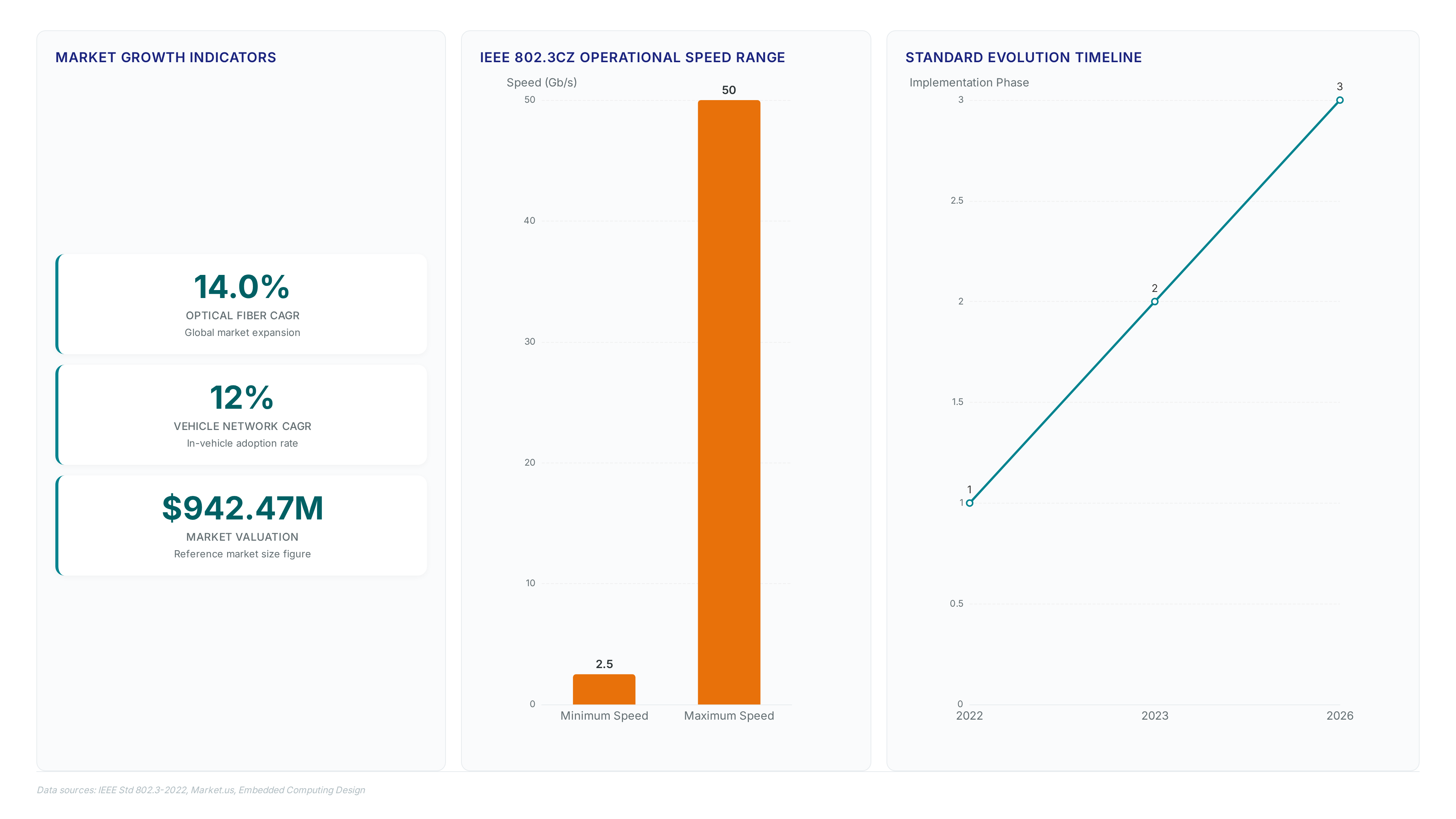
IEEE Std 802.3-2022 defines glass fiber physical layers for 2.5 Gb/s to 50 Gb/s operation. This amendment replaces heavy copper harnesses that suffer electromagnetic interference at high frequencies. Multimode silica cores compatible with VCSEL transceivers sustain bandwidth over zonal distances. High-speed capabilities exist alongside a gap in unified Point-to-Multipoint standards for shared optical topologies. Engineers prioritize point-to-point links today while monitoring Chinese consortiums developing V-PON protocols for future consolidation.
Adoption requires strict adherence to the following integration sequence:
- Validate optoelectronic devices against IEEE 802.3cz timing parameters rather than generic telecom specs.
- Replace copper backbone segments with silica fibers protected by Miniflex tubing for vibration resistance.
- Configure Ethernet switches to support TSN over the new optical physical layer interfaces.
Skipping step one causes latent packet loss during rapid thermal cycling in engine compartments. Hinge Technology and Zhongji InnoLight supply compliant modules meeting these rigorous automotive environmental constraints.
Deploying Passive Optical Splitters in Vehicle Network Topologies
WDM technology transmits multiple signals over single fibers, bypassing the lack of automotive PON standards per current industry analysis. Engineers integrate passive optical splitters to convert point-to-point links into shared P2MP topologies, reducing use weight without active repeaters. Wavelength division carries distinct data streams for 8K displays and LiDAR sensors simultaneously. The absence of ratified automotive PON protocols forces reliance on telecom-derived components lacking specific vibration hardening. Hinge Technology and Zhongji InnoLight offer architectural solutions, yet supply chains remain fragmented compared to established Ethernet vendors. Reconstructing the entire optical supply chain for high-isolation PLC chips drives up costs.
Implementation requires strict adherence to physical layer constraints despite protocol gaps:
- Select silica optical fibers with proven resistance to continuous full-band vibration.
- Configure optical splitters with low return loss to prevent signal degradation across zonal boundaries.
- Validate VCSEL transceiver compatibility against non-standard latency requirements.
- Isolate splitter nodes from high-temperature engine zones using specialized Miniflex tubing.
Products and Brands recommends verifying vendor participation in ISO 24581 drafting groups before deployment. Unified standards do not exist, so interoperability between splitter units and head-end controllers depends entirely on custom integration rather than plug-and-play compliance.
Mitigating Signal Degradation and Vibration Reliability Risks
ZF and Joyson Electronics modules must survive high-G vibration tests that exceed standard telecom specifications to prevent intermittent link failure. Optical interconnects allow cable routing near high-voltage lines without signal integrity risks, yet mechanical stress remains the primary cause of field return failures in zonal architectures. Validation requires subjecting harnesses to acceleration profiles simulating decades of road roughness within compressed test cycles. Suppliers like Hinge Technology and Zhongji InnoLight often optimize for static insertion loss rather than dynamic stability under load. Fibers maintain low attenuation at rest but suffer micro-bend losses during aggressive cornering or braking events.
| Failure Mode | Root Cause | Mitigation Strategy |
|---|---|---|
| Micro-bend Loss | Use tension during vibration | Strain-relief clamping every 15cm |
| Connector Fretting | Poor mating surface hardness | Gold-plated ferrules required |
| Core Fracture | Excessive bend radius violation | Miniflex tubing protection |
Strict component validation protocols are necessary before approving designs for production vehicles.
- Verify supplier participation in IEEE Std 802.3-2022 working groups.
- Demand dynamic vibration data alongside static optical loss charts.
- Inspect connector hardening for high-frequency resonance damping.
Total link collapse during vehicle operation is the cost of neglecting these mechanical validations.
About
Mark Phillips - Editor, Aftermarket Intel brings over 16 years of global automotive media expertise to this analysis of automotive optical fiber communication. As a seasoned industry observer who has covered major technology shifts across Asia and Europe, Phillips is uniquely qualified to dissect the complex transition toward 10+Gbps high-speed links in modern vehicles. His daily work involves tracking how emerging technologies reshape the aftermarket supply chain, directly connecting to the report's focus on OEM architectures and component manufacturers. Through Aftermarket Intel, Phillips monitors how brands like those distributed by KZMALL Russia (Enter LLC) must adapt to evolving vehicle connectivity standards. While KZMALL specializes in physical consumables and parts, understanding the underlying data infrastructure is critical for distributors navigating the future of automotive electronics. This article leverages Phillips' extensive network and AAP certification to provide factual insights into how optical Ethernet and PON technologies will influence part compatibility and distribution strategies through 2026.
Conclusion
The transition to optical backbones collapses not at the speed limit, but at the mechanical integration point where static lab specs meet dynamic road stress. While copper fails electronically due to EMI and weight, glass fails physically through micro-bend losses induced by vibration, a distinction most current validation protocols ignore. The industry faces a critical inflection point: without adopting dynamic stability metrics alongside traditional insertion loss data, next-generation zonal architectures will suffer intermittent link failures that static testing cannot predict. This is not a future risk; it is an immediate reliability trap for any program locking in suppliers today based solely on bandwidth claims.
Organizations must mandate vibration-correlated optical performance data in all RFPs issued before Q4 2027, rejecting any vendor unable to prove signal integrity under high-G acceleration profiles. Relying on telecom-grade components for automotive environments is a strategic error that will inflate warranty costs as vehicle electrification accelerates. The window to establish these mechanical baselines before mass deployment closes rapidly as supply chains harden around inferior, non-automotive-grade interconnects.
Start this week by auditing your current supplier's test reports specifically for dynamic vibration data rather than static attenuation charts. If their documentation lacks acceleration profile results, flag them as high-risk immediately.
Frequently Asked Questions
Why does copper wiring fail for high-speed automotive data links?
What speed range do new physical layer specs support on glass fiber?
How does optical fiber reduce electromagnetic interference costs compared to copper?
Which suppliers are currently proposing automotive optical fiber Ethernet solutions?
What protocol standard does automotive optical fiber Ethernet comply with?